During the Summer the Packing Houses Were in Full Activity Again
CONSTITUTIONAL RIGHTS FOUNDATION
Neb of Rights in Activity
FALL 2008 (Volume 24, No. 1)
Reform
Communism, Capitalism, and Commonwealth in Mainland china | Upton Sinclair's The Jungle | John Dewey and the Reconstruction of American Commonwealth
Upton Sinclair's The Jungle:
Muckraking the Meat-Packing Industry
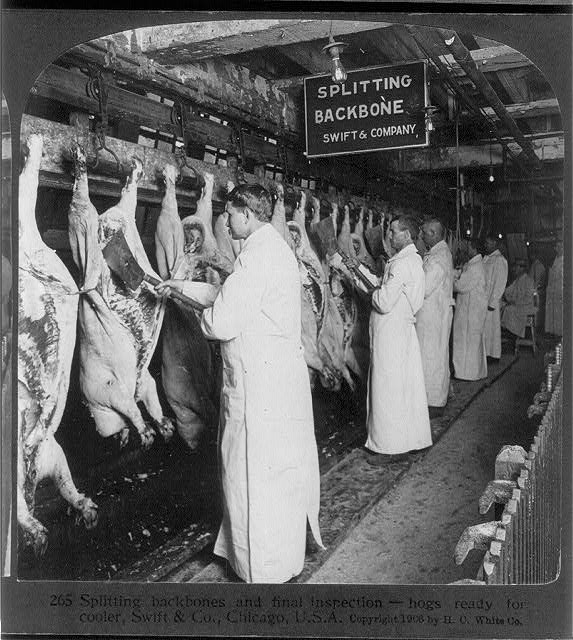 Upton Sinclair wrote The Jungle to expose the appalling working conditions in the meat-packing industry. His description of diseased, rotten, and contaminated meat shocked the public and led to new federal nutrient rubber laws.
Before the plough of the 20th century, a major reform motion had emerged in the United states. Known as progressives, the reformers were reacting to problems caused past the rapid growth of factories and cities. Progressives at first concentrated on improving the lives of those living in slums and in getting rid of abuse in regime.
By the beginning of the new century, progressives had started to attack huge corporations similar Standard Oil, U.South. Steel, and the Armour meat-packing company for their unjust practices. The progressives revealed how these companies eliminated contest, set high prices, and treated workers as "wage slaves."
The progressives differed, still, on how best to command these big businesses. Some progressives wanted to break upwardly the big corporations with anti-monopoly laws. Others thought state or federal authorities regulation would exist more constructive. A growing minority argued in favor of socialism, the public buying of industries. The owners of the large industries dismissed all these proposals: They demanded that they be left solitary to run their businesses equally they saw fit.
Theodore Roosevelt was the president when the progressive reformers were gathering strength. Assuming the presidency in 1901 later on the assassination of William McKinley, he remained in the White House until 1909. Roosevelt favored large-calibration enterprises. "The corporation is here to stay," he alleged. Merely he favored authorities regulation of them "with due regard of the public as a whole."
Roosevelt did not always approve of the progressive-minded journalists and other writers who exposed what they saw as corporate injustices. When David Phillips, a progressive journalist, wrote a series of manufactures that attacked U.S. senators of both political parties for serving the interests of large business rather than the people, President Roosevelt thought Phillips had gone likewise far. He referred to him as a homo with a "muck-rake."
However, Roosevelt had to acknowledge, "At that place is filth on the flooring, and it must be scraped up with the muck-rake." The term "muckraker" caught on. Information technology referred to investigative writers who uncovered the dark side of society.
Few places had more "filth on the floor" than the meat- packing houses of Chicago. Upton Sinclair, a largely unknown fiction writer, became an "adventitious muckraker" when he wrote a novel most the meat-packing industry.
Packingtown
By the early on 1900s, four major meat-packing corporations had bought out the many small slaughterhouse companies throughout the United States. Because they were so big, the Armour, Swift, Morris, and National Packing companies could dictate prices to cattle ranchers, feed growers, and consumers.
The Big Four meat-packing companies centralized their operations in a few cities. Largest of all was the meat-packing industry in Chicago. It spread through acres of stockyards, feed lots, slaughterhouses, and meat-processing plants. Together with the nearby housing surface area where the workers lived, this part of Chicago was known every bit Packingtown.
Long before Henry Ford adapted information technology to automobile production, meat packers had developed the start industrial associates line. It was more accurately a "disassembly line," requiring nearly fourscore separate jobs from the killing of an animal to processing its meat for sale. "Killing gangs" held jobs like "knockers," "rippers," "leg breakers," and "gutters." The brute carcasses moved continuously on hooks until processed into fresh, smoked, salted, pickled, and canned meats. The organs, basic, fat, and other scraps ended up as lard, lather, and fertilizer. The workers said that the meat-packing companies "used everything but the squeal."
Unskilled immigrant men did the arduous and often dangerous work, laboring in dark and unventilated rooms, hot in summertime and unheated in winter. Many stood all mean solar day on floors covered with claret, meat scraps, and foul water, wielding sledgehammers and knives. Women and children over fourteen worked at meat trimming, sausage making, and canning.
Virtually workers earned just pennies per hour and worked ten hours per day, six days a week. A few skilled workers, however, fabricated as much as 50 cents an 60 minutes as "pacesetters," who sped upwards the assembly line to maximize production. The use of pacesetters caused neat discontent among the workers.
By 1904, almost of Chicago's packing-business firm workers were recent immigrants from Poland, Slovakia, and Lithuania. They crowded into tenement apartments and rented rooms in Packingtown, next to the stinking stockyards and four city dumps.
Existent estate agents sold some immigrants pocket-sized houses on credit, knowing that few would be able to keep upwardly with the payments due to job layoffs, pay cuts, or disabling injuries. When an immigrant fell behind in payments, the mortgage holder would foreclose, repaint, and sell the house to another immigrant family.
Upton Sinclair
Born in Baltimore in 1878, Upton Sinclair came from an old Virginia family. The Civil State of war had wiped out the family's wealth and state holdings. Sinclair's male parent became a traveling liquor salesman and alcoholic. The time to come writer'due south mother wanted him to become a government minister. At age 5, he wrote his outset story. It told nigh a sus scrofa that ate a pin, which ended up in a family's sausage.
When he was 10, Sinclair'southward family moved to New York Metropolis where he went to school and college. While attending Columbia Academy, he began to sell stories to magazines. He specialized in western, run a risk, sports, and war-hero fiction for working-form readers.
Sinclair graduated from Columbia in 1897, and three years later he married Meta Fuller. They had one child. Sinclair began to write novels but had difficulty getting them published.
As he was struggling to make a living as a writer, he began reading about socialism. He came to believe in the idea of a peaceful revolution in which Americans would vote for the regime to have over the ownership of big businesses. He joined the Socialist Party in 1903, and a year later he began to write for Appeal to Reason, a socialist magazine.
In 1904, the meat-packer's union in Chicago went on strike, demanding better wages and working atmospheric condition. The Big Iv companies broke the strike and the marriage by bringing in strikebreakers, replacements for those on strike. The new workers kept the assembly lines running while the strikers and their families fell into poverty.
The editor of Appeal to Reason suggested that Sinclair write a novel about the strike. Sinclair, at age 26, went to Chicago at the end of 1904 to research the strike and the conditions suffered by the meat-packing workers. He interviewed them, their families, lawyers, doctors, and social workers. He personally observed the bloodcurdling atmospheric condition inside the meat-packing plants.
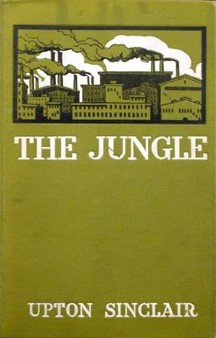 The Jungle
The Jungle is Sinclair'due south fictionalized account of Chicago's Packingtown. The title reflects his view of the brutality he saw in the meat-packing business concern. The story centered on a young human, Jurgis Rudkis, who had recently immigrated to Chicago with a grouping of relatives and friends from Lithuania.
Total of promise for a better life, Jurgis married and bought a house on credit. He was elated when he got a job as a "shoveler of guts" at "Durham," a fictional business firm based on Armour & Co., the leading Chicago meat packer.
Jurgis soon learned how the company sped up the assembly line to squeeze more work out of the men for the same pay. He discovered the company cheated workers past not paying them annihilation for working part of an 60 minutes.
Jurgis saw men in the pickling room with skin diseases. Men who used knives on the sped-upward associates lines oft lost fingers. Men who hauled 100-pound hunks of meat crippled their backs. Workers with tuberculosis coughed constantly and spit blood on the flooring. Right side by side to where the meat was processed, workers used primitive toilets with no soap and water to make clean their hands. In some areas, no toilets existed, and workers had to urinate in a corner. Lunchrooms were rare, and workers ate where they worked.
Virtually equally an afterthought, Sinclair included a affiliate on how diseased, rotten, and contaminated meat products were processed, doctored by chemicals, and mislabeled for sale to the public. He wrote that workers would process dead, injured, and diseased animals after regular hours when no meat inspectors were around. He explained how pork fat and beefiness scraps were canned and labeled every bit "potted chicken."
Sinclair wrote that meat for canning and sausage was piled on the flooring earlier workers carried it off in carts holding sawdust, human spit and urine, rat dung, rat poison, and even dead rats. His nearly famous clarification of a meat-packing horror concerned men who roughshod into steaming lard vats:
. . . and when they were fished out, at that place was never enough of them left to be worth exhibiting,--sometimes they would exist disregarded for days, till all only the bones of them had gone out to the world as Durham'due south Pure Leafage Lard!
Jurgis suffered a series of heart-wrenching misfortunes that began when he was injured on the assembly line. No workers' compensation existed, and the employer was not responsible for people injured on the job. Jurgis' life fell apart, and he lost his wife, son, house, and chore.
And then Jurgis met a socialist hotel possessor, who hired him as a porter. Jurgis listened to socialist speakers who appeared at the hotel, attended political rallies, and drew inspiration from socialism. Sinclair used the speeches to express his ain views about workers voting for socialist candidates to take over the authorities and end the evils of backer greed and "wage slavery."
In the final scene of the novel, Jurgis attended a celebration of socialist ballot victories in Packingtown. Jurgis was excited and once more hopeful. A speaker, probably modeled after Socialist Party presidential candidate Eugene V. Debs, begged the crowd to "Organize! Organize! Organize!" Do this, the speaker shouted, and "Chicago will be ours! Chicago will be ours! CHICAGO Will Be OURS!"
The Public Reaction
The Jungle was kickoff published in 1905 as a series in The Appeal to Reason and then equally a book in 1906. Sales rocketed. It was an international best-seller, published in 17 languages.
Sinclair was dismayed, however, when the public reacted with outrage about the filthy and falsely labeled meat but ignored the plight of the workers. Meat sales dropped sharply. "I aimed at the public'due south heart," he said, "and by accident I hit it in the stomach."
Sinclair thought of himself as a novelist, not as a muckraker who investigated and wrote about economic and social injustices. But The Jungle took on a life of its own as ane of the not bad muckraking works of the Progressive Era. Sinclair became an "accidental muckraker."
The White Business firm was bombarded with postal service, calling for reform of the meat-packing industry. After reading The Jungle, President Roosevelt invited Sinclair to the White House to hash out it. The president and then appointed a special committee to investigate Chicago's slaughterhouses.
The special commission issued its report in May 1906. The report confirmed well-nigh all the horrors that Sinclair had written near. One solar day, the commissioners witnessed a slaughtered hog that vicious part fashion into a worker toilet. Workers took the carcass out without cleaning information technology and put it on a claw with the others on the associates line.
The commissioners criticized existing meat-inspection laws that required only confirming the healthfulness of animals at the time of slaughter. The commissioners recommended that inspections take place at every stage of the processing of meat. They as well called for the secretarial assistant of agriculture to make rules requiring the "cleanliness and wholesomeness of creature products."
New Federal Food Laws
President Roosevelt called the atmospheric condition revealed in the special commission's written report "revolting." In a letter to Congress, he declared, "A law is needed which will enable the inspectors of the [Federal] Government to inspect and supervise from the hoof to the can the preparation of the meat food production."
Roosevelt overcame meat-packer opposition and pushed through the Meat Inspection Human action of 1906. The police authorized inspectors from the U.South. Department of Agriculture to stop whatsoever bad or mislabeled meat from inbound interstate and strange commerce. This law greatly expanded federal regime regulation of private enterprise. The meat packers, nonetheless, won a provision in the law requiring federal regime rather than the companies to pay for the inspection.
Sinclair did non like the law'south regulation approach. True to his socialist convictions, he preferred meat-packing plants to be publicly owned and operated by cities, every bit was unremarkably the case in Europe.
Passage of the Meat Inspection Act opened the manner for Congress to approve a long-blocked law to regulate the sale of most other foods and drugs. For over 20 years, Harvey Westward. Wiley, chief chemist at the Department of Agriculture, had led a "pure food cause." He and his "Poison Team" had tested chemicals added to preserve foods and found many were dangerous to human wellness. The uproar over The Jungle revived Wiley's lobbying efforts in Congress for federal food and drug regulation.
Roosevelt signed a police regulating foods and drugs on June 30, 1906, the same day he signed the Meat Inspection Human action. The Pure Nutrient and Drug Act regulated food additives and prohibited misleading labeling of food and drugs. This law led to the formation of the federal Food and Drug Administration (FDA).
The 2 1906 laws ended up increasing consumer confidence in the food and drugs they purchased, which benefitted these businesses. The laws as well acted as a wedge to expand federal regulation of other industries, ane of the strategies to command large business organisation pursued by the progressives.
After The Jungle
The Jungle fabricated Upton Sinclair rich and famous. He started a socialist colony in a l-room mansion in New Jersey, but the building burned downward subsequently a year. In 1911, his married woman ran off with a poet. He divorced her, just presently he remarried and moved to California.
During his long life, he wrote more than 90 novels. King Coal was based on the 1914 massacre of striking miners and their families in Colorado. Boston was almost the highly publicized case of Sacco and Vancetti, two anarchists tried and executed for bank robbery and murder in the 1920s. His novel Dragon'southward Teeth, about Nazi Deutschland, won the 1943 Pulitzer Prize. None of these novels, even so, achieved the success of The Jungle.
Several of Sinclair's books were made into movies. In 1914, Hollywood released a movie version of The Jungle. Recently, his piece of work Oil!, which dealt with California's oil manufacture in the 1920s, was made into the film There Will Exist Blood.
During the Dandy Low, Sinclair entered electoral politics. He ran for governor of California as a socialist in 1930 and as a Democrat in 1934. In the 1934 ballot, he promoted a program he called "End Poverty in California." He wanted the state to purchase idle factories and abandoned farms and charter them to the unemployed. The Republican incumbent governor, Frank Merriam, defeated him, but Sinclair however won over 800,000 votes (44 per centum).
Afterward the death of his second wife in 1961, Sinclair moved to New Jersey to be with his son. He died there in 1968 at age 90.
People withal read The Jungle for its realistic picture show of weather condition in the meat-packing manufacture at the turn of the 20th century. Like Harriet Beecher Stowe's Uncle Tom's Cabin, The Jungle proved the power of fiction to move a nation.
For Discussion and Writing
1. Why did the existing inspection system fail to baby-sit the safety of meat for human consumption?
2. Why was Upton Sinclair dismayed about the public reaction and legislation that followed publication of The Jungle?
3. How did The Jungle help the progressives reach their goals?
For Farther Reading
Mattson, Kevin. Upton Sinclair and the Other American Century. Hoboken, N. J.: John Wiley & Sons, 2006.
Phelps, Christopher, ed. The Jungle by Upton Sinclair. Boston: Bedford/St. Martin's, 2005.
A C T I 5 T Y
Working in Packingtown
Upton Sinclair was disappointed that Congress did not accost the injustices suffered past workers in Packingtown's meat-packing manufacture. Take on the role of a muckraker and write an editorial that details the injustices to workers and what Congress should practise about them.
A 50 T E R N A T I V E A C T I Five I T Y
A Mod Muckraker
Look at a contemporary problem in the community, state, or nation. Investigate it. Write an editorial on what should be done about it.
Source: https://www.crf-usa.org/bill-of-rights-in-action/bria-24-1-b-upton-sinclairs-the-jungle-muckraking-the-meat-packing-industry.html
0 Response to "During the Summer the Packing Houses Were in Full Activity Again"
Post a Comment